
Reflection
What kind of KAR do you drive?
That's not a typo for "car." It stands for Knowledge, Action, Result.
Throughout our lives, we learn new knowledge.
We sometimes feel FOMO (Fear of Missing Out) when we're not informed about something.
We sometimes feel incompetent when others know more than we do.
The truth is that you probably know something that others don't know, and vice versa.
Accumulating knowledge is the way to live.
But knowing something is only the first step.
Until you take Actions, nothing is going to change.
Actions are what make the knowledge practical and applicable.
Actions are what lead to the invention of new products and services.
Knowledge guides your actions. Actions generate your Results.
Don't let your knowledge sit still.
Put it to work.
Drive your KAR.
What action will you take this week?
Explain to me like a 85-year old
Ever tried to explain a technical concept to an elderly person who isn't tech-savvy?
A few weeks ago, my mom complained that her phone was way too slow.
I found 30+ applications running in the background.
Mom asked, "Why is it so slow?"
I couldn't explain technical terms like CPUs and memory, and I couldn't get into the details of background processes.
I had to think of a different way.
I said: "Mom, look at me!"
Once I had mom's attention on me, I continued,
"I have something in my left hand, something in my right hand, something on my left foot, and something on my right foot. I even have something around my neck.
Now, if you ask me to carry something else, I can't.
Your phone is similar.
It was having too many apps running, and it's like me carrying too many things.
When I close the apps on your phone, it's like I am removing all of those things from my feet, my neck, and my hands.
Now I can carry whatever you want to take.
Similarly, your phone can now do what you want it to do."
Mom said, "I see! That makes perfect sense!"
As leaders, our job isn't to show how much we know and how many technical jargon terms we can leverage, but to communicate with empathy and clarity.
Great leadership is about making the complex feel simple.
Outstanding leadership is about communicating in a "language" the other person can understand.
It’s YOUR Time
The airline informed you that your flight is delayed and you will miss your connecting international flight.
You are mad, upset, and frustrated.
You curse the government for being shut down.
You curse the politicians.

Mount Fuji
Or
You can accept the reality.
Reschedule your booked taxi pickup on the other side of the world,
Cancel your hotel overseas,
Change your itinerary to stay in one city instead of two due to the shortened trip.
Book a new hotel.
Cancel the high-speed train pass.
The result? You enjoyed a newly updated vacation.
It is YOUR time.
You can use it to be mad and sad,
Or you can use it to be joyful and productive.
It is YOUR choice.
The time is yours.
Time is the only commodity we each have.
Use it wisely.
The government isn't responsible for your happiness.
The airline isn't going to pay you back for your time.
The above scenario is a true story during our recent trip to Japan.
What's your story of how you used your time wisely in the time of unplanned disruption?
You want more power?
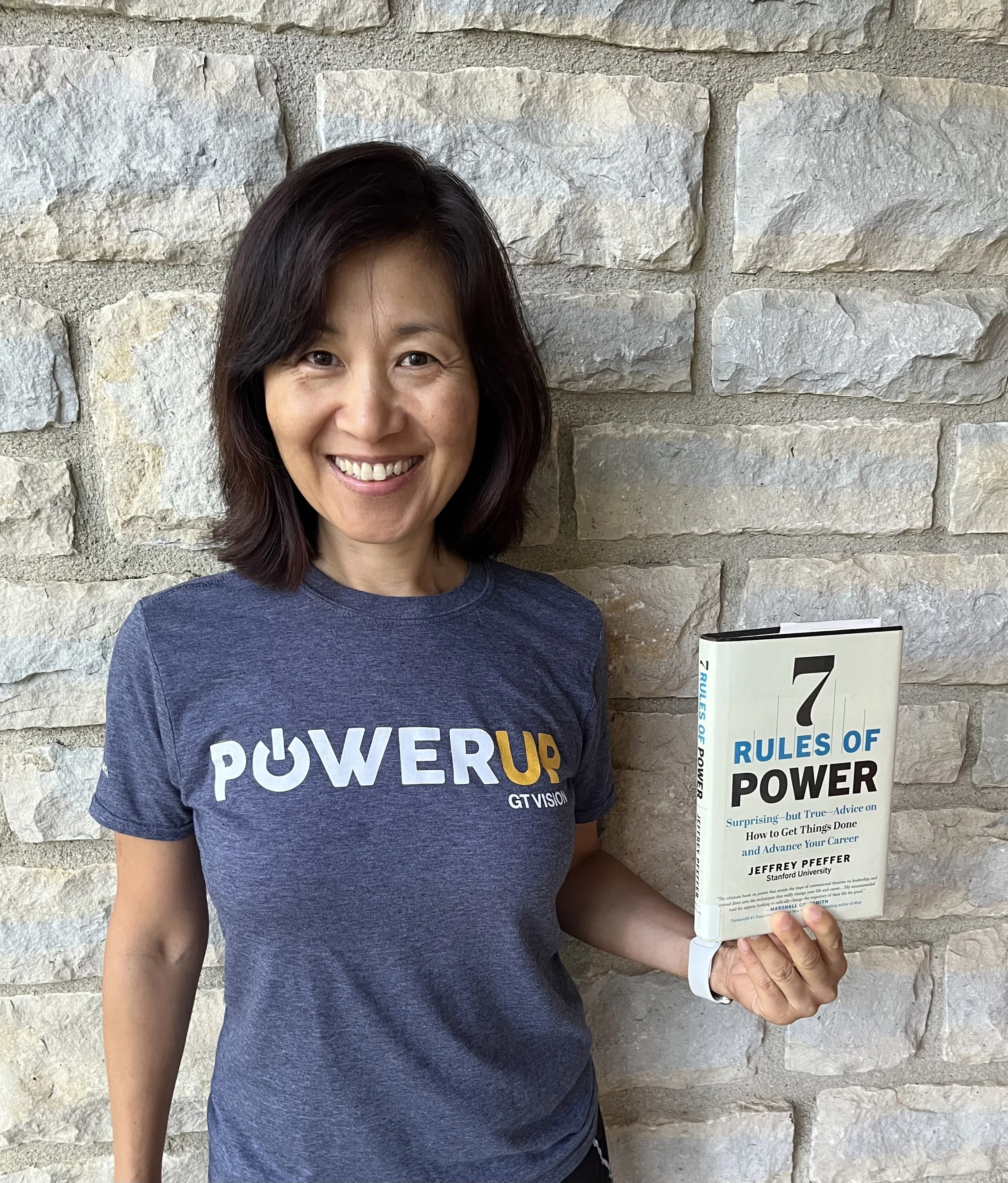
7 Rules of Power
First, get out of your own way.
Many people have a negative perception of having power.
Power by itself is neutral.
It depends on how we use it.
When power is used for the betterment of society, we need more people with more power.
We often struggle with imposter syndrome or an inner critic.
🟠 Afraid to speak up during a meeting, ask yourself why.
🟠 Not comfortable sharing your achievements, ask yourself why.
🟠 Not asking for a promotion, ask yourself why.
Many of us fall into the trap of Authenticity.
🟠 We believe that Authenticity is in conflict with being powerful. You can have both simultaneously.
🟠 "Be true to what others want you to be" may be more important than "to be true to yourself" (You may have to think about this one...Leaders adapt their styles depending on who they are working with instead of sticking to their own rigid styles)
Many of us are overly concerned about whether others like us.
But likeability is a double-edged sword.
🟠 Being liked is a source of power.
🟠 If you are pursuing it too much, you can be seen as less competent.
Acknowledge and accept who you are but not let that identity to define who you will be forever.
Thank you Dave Lu for recommending the book "7 Rules of Power" by Dr. Jeffrey Pfeffer.
In my coaching for Women In Tech, I often work with them to get out of their own way to elevate their power.
My reading list of 2024
Reading is personal, I enjoy having dialogs with people who are wise. My past sharing of books has encouraged others to read some of my picks. Here is my list for 2024, without any particular order.

Unreasonable Hospitality: The Remarkable Power of Giving People More Than They Expect by Will Guidara
Unlearning Silence: How to Speak Your Mind, Unleash Talent, and Live More Fully by Elaine Lin Hering
The Power of Voice: A Guide to Making Yourself Heard by my beloved coach Denise Woods (reread)
The Last Lecture by Randy Pausch and Jeffrey Zaslow (reread)
Becoming Coachable: Unleashing the Power of Executive Coaching to Transform Your Leadership and Life by Scott Osman, Jacquelyn Lane, Marshall Goldsmith
Permission to Speak: How to Change What Power Sounds Like, Starting with You by Samara Bay (reread)
ImmiGRIT: How Immigrant Leadership Drives Business Success by my friend Ukeme Awakessien Jeter
Good Guys: How Men Can Be Better Allies for Women in the Workplace by David Smith and Brad Johnson
The Accidental Sexist: A handbook for men on workplace diversity and inclusion by Gary Ford, Stephen Koch and Dr Jill Armstrong
The 100X Leader: How to Become Someone Worth Following by Jeremie Kubicek - Speaker/Best Selling Author and Steve Cockram
The Strangest Secret by Earl Nightingale, recommended by my best friend Joy Zhao, M.D., Ph.D, PCC
Shoe Dog: A Memoir by the Creator of Nike by Phil Knight, a gift from a dear friend.
Book more business: Make MORE. Money speaking by my mentor Lois Creamer
Useful Not True by Derek Sivers, a gift from my husband
Write your story - a simple framework to understand yourself, your story, and your purpose in the world by Allison Fallon
Likeable Badass: How Women Get the Success They Deserve by Alison Fragale
15 Lies Women Are Told at Work: …And the Truth We Need to Succeed by Bonnie Hammer
Unmasking AI: My Mission to Protect What Is Human in a World of Machines by Dr. Joy Buolamwini, a gift from Women in Analytics (WIA) during DataConnect Conference
Turn your leaning tower to triumph

The Leaning Tower of Pisa, a freestanding bell tower in Pisa, Italy, is world-renowned for its unintended lean, caused by an unstable foundation. The initial construction that's started in 1173 was paused, and then resumed with modified design. The construction was eventually finished after ~200 years. Then it was closed to the public in 1990 due to safety concerns. After extensive re-engineering for nearly 10 years, it's reopened to the public.
Each year, the tower receives ~5 million visitors approximately.
The reason that the tower attracts so many visitors is not because the tower is perfectly straight. It's the opposite! It's the imperfection.
Just like the tower, our journeys are often filled with unexpected twists and turns. What if our "imperfections" are actually our greatest strengths? Let's embrace our unique perspectives and lean into our "tilt."
Design your life
5 years ago...
I was a single mother, raising two children on my own, a college student and a high school student.
I was paying a mortgage, a car loan and college tuition.
I was leading a global technology team in one of the largest financial companies. We were working day and night on one of the most challenging programs - moving the entire HR systems to the Cloud.
One day, a potential life changing opportunity arrived at my door. It was a leadership and life development program through a coaching school.
I lost sleep....how am I going to pay $10,000+ for the coaching school tuition and have the 500+ hours needed to study?
I found the way, and the rest is history.
Today...
My college student graduated with multiple honors and is free of debt. The younger one is in their dream college.
I got married to my current husband, my soulmate and my love.
I retired from my high-profile and high-paying technology executive job.
I started my entrepreneurship path to develop more great leaders.
Most important, I am living a fulfilled life beyond my imagination, largely because I designed my own life during my coaching school 5 years ago.
Now, I want you to experience what I have experienced - a full day coaching intensive to support you on the next level leadership journey. Are you ready to take control of your life and live it to the fullest?
How do you amplify your impact?
You finished your program, you then moved on to the next.
How often do you pause and think:
How can I amplify my impact?
Who else can benefit the work that's completed?
Who can help amplify the adoption?
These questions would allow your work to be scaled and reused.
So, here is an example.
Last week, I gave a presentation on "Supercharge Your Presentation Impact with AI". It was greatly received. Afterwards, several people asked for a digital copy. A hard copy was distributed during the event. A digital copy was provided in the event follow up communication.
However, I thought about how this can be made beneficial to people who didn't attend my presentation. In the meantime, it can also give me flexibility to update the list as AI tools are ever-evolving.
So here it is. I made it available to anyone who is interested.
What's your secret to amplifying your impact? Share your strategies in the comments!
P.S. invite me to your company/team for an interactive working session on the adoption of AI Tools.
What would you say?
At a recent event when I was sharing my career journey with a group of vibrant engineering students, a bright young mind asked me a powerful question: "With one sentence, what advice would you give your 18-year-old self?"
Tough question! Not because the answer wasn't clear, but because I was limited to ONE sentence. Talk about a challenge! In reality, I could write a whole book on this.
But here's the one sentence I landed on (I had to think on my feet): “Don’t care too much about what other people think of you, live your own life and chase your own dreams. “
I cared too much about what my parents thought of me. I wanted their approval and I didn’t want to fail them.
I cared too much what my peers thought of me. I wanted them to like me.
I cared too much about what my professors thought about me. I wanted them to appraise me intelligent.
I cared too much about what strangers thought of me - yes even strangers! I wanted them to respect me.
For a long time, I had been living THEIR lives, not mine.
Here are the questions for YOU:
Whose life are YOU living?
Whose dreams are YOU chasing?
What would YOU tell your 18-year-old self?
I am sorry that I said sorry
We've all heard it: "Sorry I'm late," "Sorry I didn't get that done," "Sorry I don't have time." It's become a common refrain, but is it always necessary?
Like many learners of English, I understand 'sorry' means causing hurt. We wouldn't hesitate to say "sorry" if we bumped someone in the store.
I want to encourage women leaders to examine when and how often they say sorry.
Is it because it's an autopilot habit? Is there any other way to express similar feeling?
Let's use this simple example: you're running five minutes late for a coffee catch-up. Traffic or a kiddo meltdown? Happens to all of us! You arrive and blurt, "So sorry!" They understand, you chat, all good.
But what if you said, "Thank you so much for waiting!"
Here's the shift: "Sorry" feels like regret, frustration, needing forgiveness. It sets an expectation that being late requires an apology.
"Thank you" radiates gratitude and appreciation. You weren't apologizing, you were showing appreciation for their patience!
Small changes, big impact! Would you like to ditch the "sorry" reflex and shine with "Thank You" instead? Try it out!